
The best canyoning activities in Mallorca
Discover the best canyoning adventures in Mallorca for all levels and experience breathtaking landscapes.
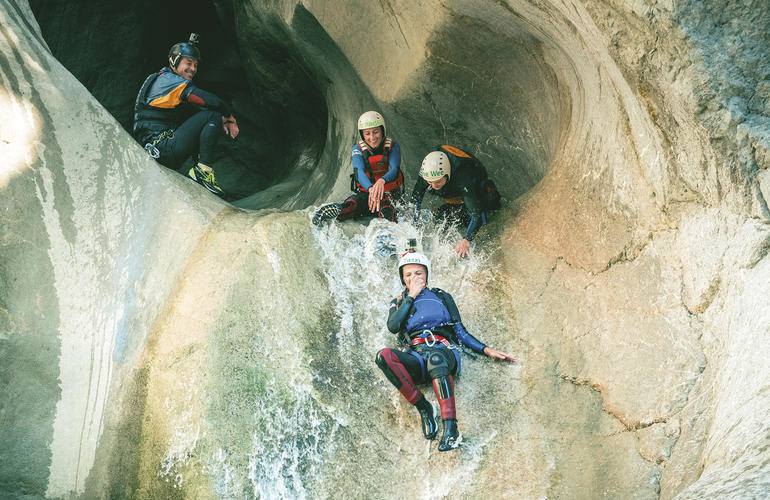
Welcome to Manawa, the website for booking outdoor activities around the world. From diving to canyoning, we connect adventure enthusiasts with professional local instructors to guarantee unforgettable experiences.
In recent years, canyoning has undoubtedly become one of the most popular outdoor activities. And for good reason! All over the world, discovering gorges and canyons, this experience offers total immersion in nature and a chance to disconnect from our fast-paced lives. Away from it all, you come face to face with pure nature, ideal for recharging your batteries.
Canyoning is also a comprehensive outdoor sport that combines a number of different activities. It's a mixture of caving, hiking and climbing, as well as white-water activities such as cliff jumping, swimming in the currents or sliding down the corridors in toboggan mode. The different levels of difficulty in the canyons and the support of professional guides mean that everyone can enjoy a canyoning trip, including children aged 6 and over. Canyoning is first and foremost a human adventure, which is most enjoyable when shared with family or a group of friends.
This comprehensive guide to canyoning gives you important advice and information before you set off to discover some magnificent canyons. Canyoning is an outdoor activity that can be dangerous if you're not careful. Find out everything you need to know about canyoning, what equipment you need, who can and can't canyoneer and where the best spots are.
Let's find out all about canyoning! Enjoy your reading!
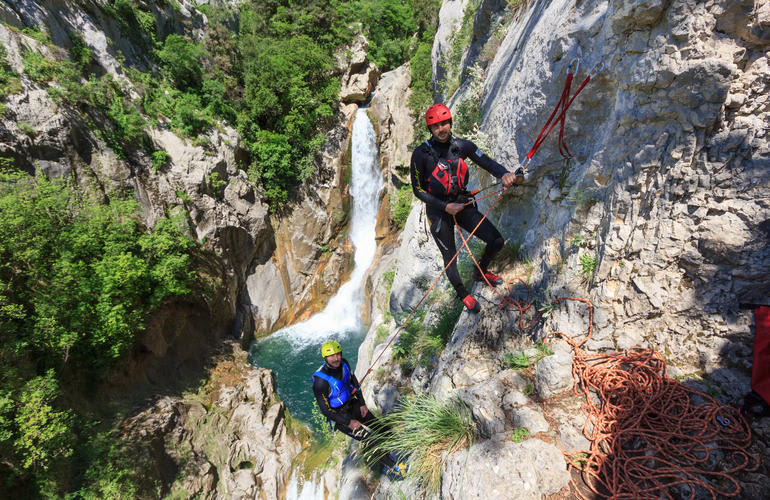
Quite simply, it's the most complete outdoor sport there is! Canyoning combines potholing, hiking, abseiling and climbing, as well as white-water activities such as cliff jumping, swimming in currents and sliding down chutes.
Discovering magnificent gorges is an activity that often begins high up in the mountains and then descends with the flow of water. Bear in mind that, except for some beginner canyons, the approach walk and the return walk are also part of the experience and can be more or less long.
With canyons at different levels of difficulty, there's something for everyone. So canyoning is an ideal activity for a group of friends or the whole family. In fact, it's a sport practised all over the world - as long as there's a beautiful canyon to discover and instructors to guide you.

The term aquatic trekking is often used as a synonym for canyoning. But is it really the same thing? No, not quite. Although very similar, there is a difference between canyoning and water trekking.
Part of the sport of canyoning, water trekking is a name coined to describe canyons without verticality and with more water sections. This activity alternates between walking, jumps and slides. Ropes and harnesses are not normally required, as there will be no abseiling.
Water trekking is generally considered to be particularly suitable for families with young children. However, there are canyoning trips for beginners as well as difficult water tours.
Find out more about the difference between canyoning and water trekking.

Coasteering is another derivative of canyoning. Instead of being encircled by a canyon and descending into the white water, you advance diagonally and jump from cliffs and rocks into the ocean.
Coasteering is a discipline invented by our British friends. Like canyoning, this adventure activity combines jumping, swimming and abseiling. Coasteering involves more climbing.
If you're more interested in the sea than white water, then this coastal canyoning is ideal for you. Take a look at the 10 best coasteering spots in Europe.
The term "canyoning" was probably first used by a member of John Wesley Powell's expedition down the Colorado River in the United States in 1869.
Many of the canyons that are now descended for pleasure were once travelled by indigenous people. The natives probably wore primitive clothing and were either barefoot or wore sandals or moccasins. The ropes used generations earlier made it possible to achieve difficult vertical descents simply by using hemp and manila ropes. Our ancestors were certainly brave!
Canyoning is practised all over the world, and each country has probably developed its own individual version. Australian hikers ventured into the local canyons in the 1950s. In the USA, hikers, climbers and paddlers explored the canyons in the 1940s and 1950s. As a result, techniques and equipment have evolved in unique ways in different countries.
Note, for example, that in Japan, unlike in Western countries, the route is taken in the opposite direction to the flow of water. The aim is to go up the source of a mountain stream in order to reach its summit. This is called "Sawanobori".
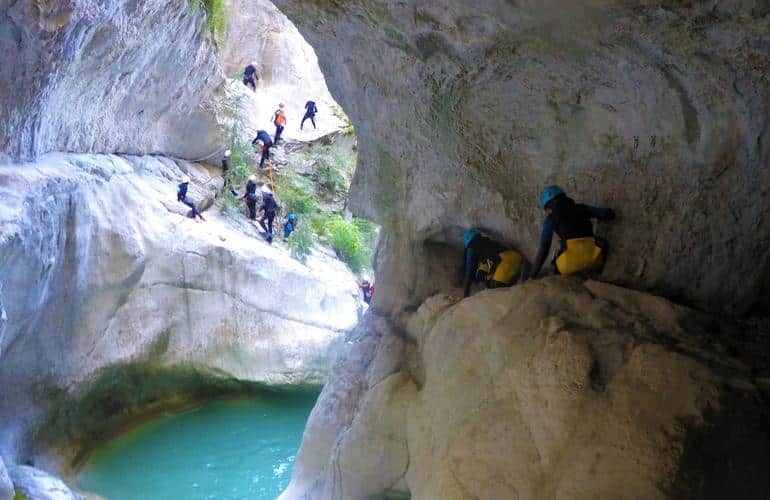
Canyoning is not only a fun sport, but also a technical one. Various methods are used in canyoning: swimming, hiking, sliding, abseiling and jumping.
Canyoning often takes place in wild, isolated gorges and in difficult environments. That's why we advise you to do this activity with a certified instructor who will guide you through the canyon and help you overcome the obstacles.
Before setting off on your adventure, the instructor will equip you (you'll find details of the equipment further down the article) and give you a short course on canyon walking and abseiling techniques. After a more or less lengthy approach walk (depending on where the canyon is located) you arrive at the starting point for the canyoning descent. It's important to remember that once you've started your descent, it's almost impossible to turn back. With the exception of beginner canyons, these often have escape routes. Depending on the canyon, you may have to walk back to the car at the end of the activity.
As well as being an unusual and highly entertaining challenge, canyoning is appreciated for its immersive nature. Surrounded by wilderness, being away from it all allows you to switch off for a few hours and concentrate on the only task at hand: getting through the canyon.
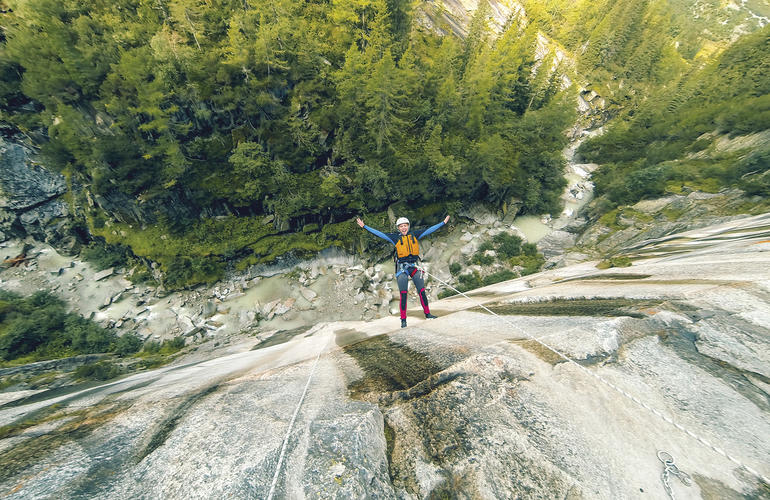
During your canyoning trip, you'll be jumping, sliding, swimming, walking, abseiling and climbing. Here are a few more details on the different ways of crossing canyon waterfalls:
There are all kinds of canyons, and the descents can range from very easy to extremely difficult, and last from 2 hours to a whole day. So before embarking on a canyoning adventure, it's important to take a look at the difficulty of the canyon and find a route that suits your abilities and desires.
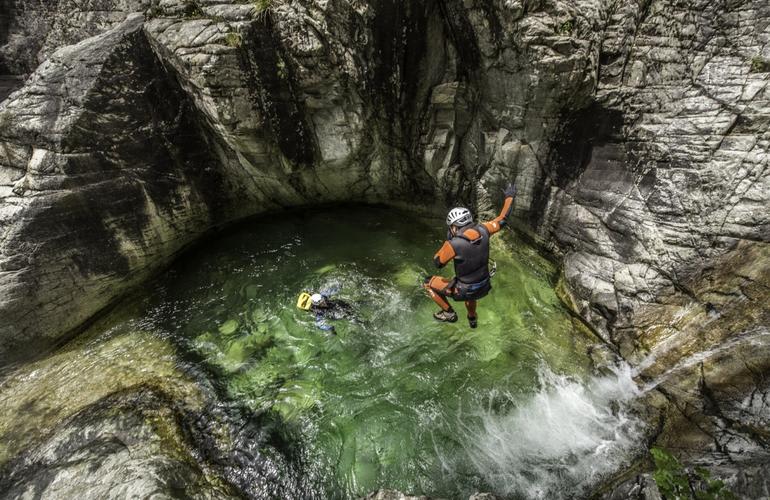
To fully understand how canyons are classified, you need to be familiar with the standardised reference system proposed by the Fédération Française de Montagne et d'Escalade (FFME). This classification system offers three ways of framing canyons:
For example, the Richiusa Canyon in Corsica is rated V3 A3 III (in the photo above). Note that this is the French classification, but it's different all over the world. To find out whether the level of the canyon is right for you, don't hesitate to ask the instructor before embarking on your adventure.
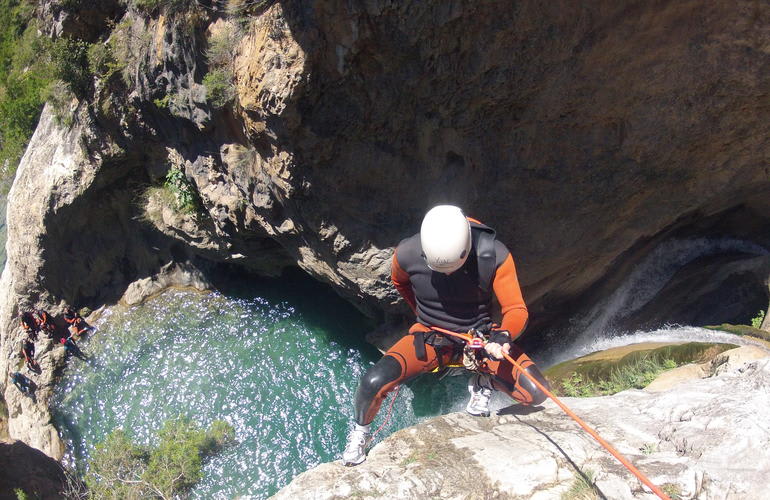
Typical canyoning trips allow children aged 12 and over to take part. However, some adapted canyons can be done with children as young as 6 and are therefore ideal for a family adventure.
While age is one factor, physical and mental fitness is another. Canyoning adventures are quite rigorous. Many trips start only after an approach walk, lasting from 2 minutes to 2 hours! The return walk can also be more or less long.
The water temperature is generally low and anyone sensitive to the cold may not enjoy the activity. However, this is rare, because between the right equipment (wetsuit, etc.) and a little stress before the activity, there's plenty to warm you up...
The most important thing is to understand that there is rarely any possibility of turning back. Only beginner canyons sometimes have escape routes. When you set out, it's to the end. Except in the event of an accident, you will not have the option of leaving the activity or going back with an instructor. Serious accidents are rare (but remember, watch your ankles), so think carefully before setting off. There are very few ways out, mainly because of the height difference and the depth of the canyon.
Some courses include jumps or abseils at height, which cannot be avoided. Some of the easier routes have alternative paths and the more difficult sections can be avoided. The best thing is to find out before you set off so that you know exactly what to expect and can decide whether or not to take part.
Last but not least, it's important to be vigilant during this activity. It requires concentration and technical manoeuvres, and your attention will be required to stay safe and have fun.
In most countries, the maximum group size is limited to 8 people. This is important, as the instructor must be able to keep a close eye on each participant to ensure their safety. If there are more than 8 people, an instructor can be added. Generally speaking, we avoid groups that are too large, to keep up the pace of the descent and avoid creating traffic jams.
What's more, it's important that all the members of your group have roughly the same level of fitness. It's not possible to split groups once you've started, and everyone must be able to finish.
Canyoning is not recommended for people suffering from vertigo or who have already suffered bone injuries, back injuries, heart problems or ankle problems. Before the activity, you must inform your instructor of any other particular medical problems. In this way, he or she will be able to help you decide whether a canyoning trip is feasible for you.
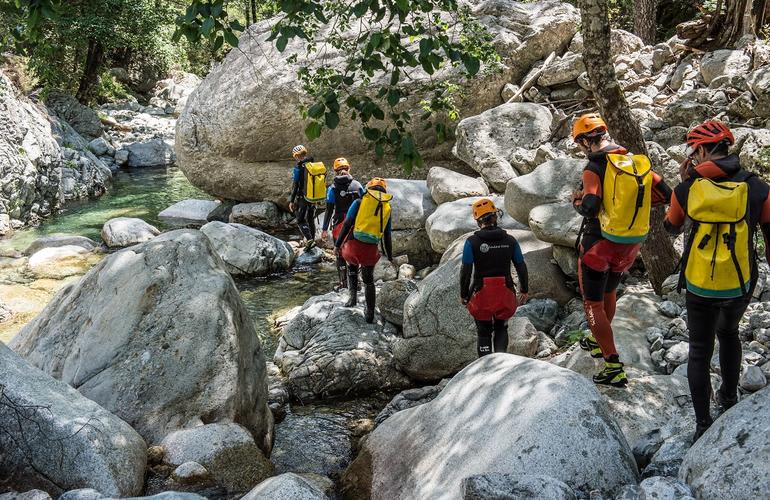
Canyoning is a technical sport that requires specific equipment. Normally, the professional provides all the necessary equipment, such as :
What you have to bring yourself:
Sometimes the professional also provides you with shoes. We recommend that you ask the instructor before your canyoning trip what you need to bring yourself.

Canyoning is a wilderness activity and should not be underestimated. If you set off with a professional guide who knows the gorge inside out and you follow his instructions, there's nothing to fear and you're in for an unforgettable adventure.
Canyoning is practised in a group, and even if you are supervised by a professional, you must take care of the people around you and stay together. It's important to adapt to the pace of the other people in your team.
To find out more about the dangers of this activity, simply ask your instructor or guide who knows the area well. For example, the presence of a hydroelectric structure (dam, power station, etc.) can cause a change in flow at any time, even if it's not raining, so don't hesitate to ask for vital information. It would seem logical to ask how deep the water is before jumping off a cliff, but as most accidents are caused by this kind of oversight, it's important to make it clear.
Even if this activity is possible for people aged 6 and over, and even if you are well supervised, it is still highly recommended and sometimes even compulsory to know how to swim if you want to try canyoning.
Drink and eat well before setting off. You need to be well hydrated for this type of outdoor activity. You'll be expending a lot of energy, as the effects of the cold, thirst and exertion will take their toll on your body and mind. So take food with slow carbohydrates and fast sugars, which will help you avoid the 'energy crash' and stay concentrated.
The activity may be cancelled due to a sudden rise in the water level, mainly caused by a thunderstorm or heavy downpour. The increased flow of water sometimes makes canyoning impossible, and as you can't control the weather, you should always have a plan B in case of bad weather. It's worth noting that canyoning centres will offer you another date or refund your money without any hassle, as they are used to dealing with this kind of problem.

Yes, you can go canyoning in winter, and it's even beautiful! Canyoning is often practised in cold, snowy places like the Alps or the Pyrenees, but it's essential to have a professional guide and the right equipment!
Near Pau, for example, you can try your hand at Ice Canyoning in the Atlantic Pyrenees. Following the same route as in summer, during your winter canyoning there may be snow and ice. That's why you'll be equipped with a 100% waterproof wetsuit, a thermal under-suit, as well as gloves, a balaclava, neoprene socks and so on. With all this equipment you can enjoy an unusual canyon descent in a magnificent winter landscape.
And if you're not keen on the idea of canyoning in the middle of winter, despite wearing a dry suit, how about winter canyoning in warm water? Still in the Pyrenees, you can go canyoning at the Thuès-les-Bains spa in the heart of the Parc Naturel Régional des Pyrénées Catalanes. At 35°C, the water is between 5 and 10 times hotter than the air!
As we've already told you, one of the advantages of canyoning is that you can do it almost anywhere in the world! As long as there's a canyon and guides, there's canyoning. Having covered all the important elements of this outdoor sport, here are the best destinations for canyoning.
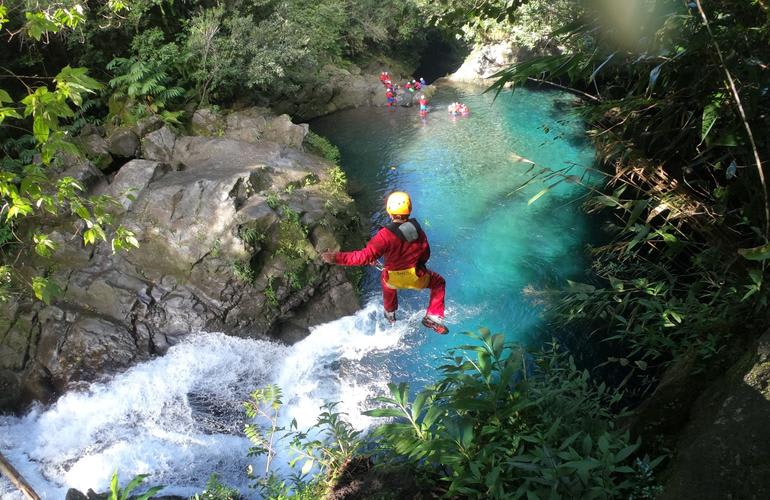
The tropical island of Réunion is known as one of the most beautiful places in the world for canyoning. The rocky basalt canyons and crystal-clear waters create fun slides. The Canyon de Fleur Jaune and Canyoning sur la Rivière Langevin (pictured above) are among the island's best-known.
Another particularly interesting canyon is the Canyon Saint Suzanne, which can be done in two sections. Either you do just the first part, called "Sainte Suzanne Classique", which is ideal for beginners and families and lasts about half a day. Or you can do the second part, called "Sainte Suzanne Intégral", which is more difficult, longer and requires a good level of fitness.
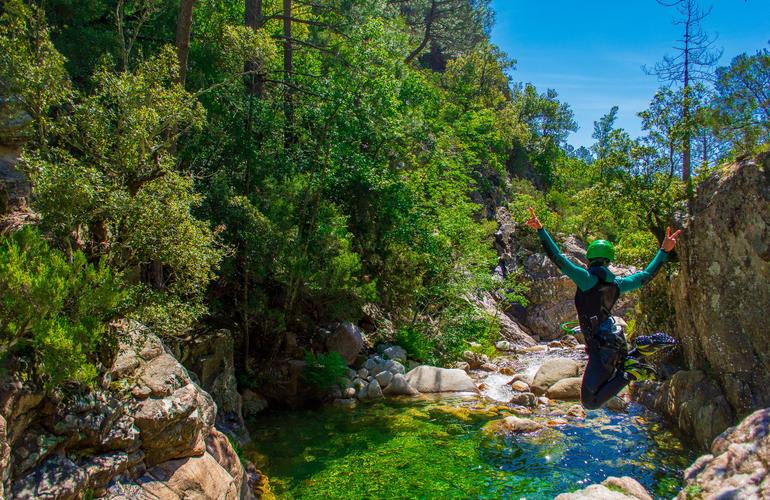
This island in the Mediterranean has more to offer than sea and beautiful beaches. Inland from Corsica, there are magnificent gorges such as the Pulischellu canyon in the Bavella massif. It's the ideal place to start and learn about this outdoor activity.
For a more advanced canyoning experience we recommend the full descent of the Dardu canyon at Piana in the south of the island. The best thing about this one-day adventure is that you'll end up in the Calanques de Piana, by the sea, and you'll be taken back by boat! Unfortunately, this adventure is only available during the spring months of April and May.

Spain offers a wide range of different canyoning options. In the north of the country, the Sierra de Guara massif in the province of Huesca will delight all canyoning enthusiasts - beginners and experienced alike. A day's canyoning in the Sierra de Guara National Park is a fun way to discover the beautiful canyons. It's almost like being in a water park!
Not to be missed if you're in southern Spain, is a half-day canyoning trip in the Guadalmina gorge near Marbella. Not far from Málaga, this canyon is ideal for a first canyoning adventure with family and friends, as it has all the fun elements: jumps of varying heights, swimming, abseiling and white-water slides.
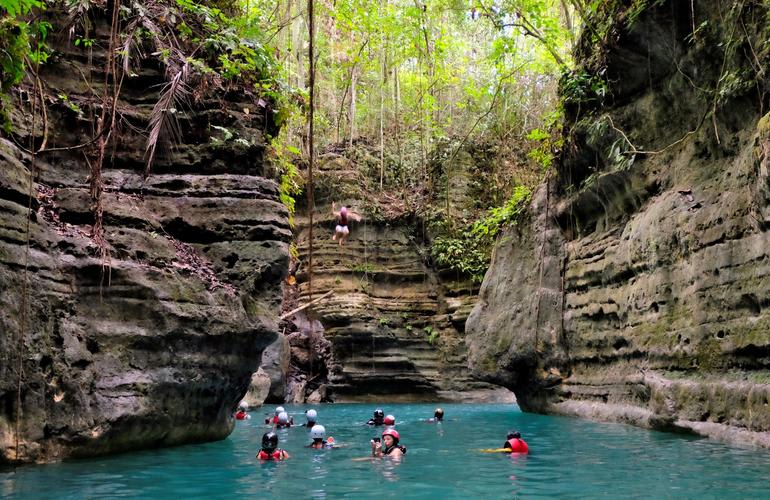
Here's a canyoning experience that will take your breath away! Located on the Philippine island of Cebu, the Kawasan Falls are a series of magnificent waterfalls in the middle of the jungle. Discover them in an unusual way. It's the perfect canyon for adventurous beginners. Because the trip includes jumps and slides of up to 10?m, you'll need to know how to swim.
Once you've reached the main pool at Kawasan, you can enjoy a delicious Filipino lunch. Canyoning at Kawasan Falls in the rainforest is undoubtedly an unforgettable experience!

In the United States, in the state of Utah, you'll find Zion National Park. A paradise for climbers, hikers and, with several hundred canyons, for canyoning enthusiasts. Unlike the gorges seen above, the canyons of Zion have many abseiling descents and only a few passages where you have to swim. Canyoning USA provides detailed information on each gorge, indicating the level and skills required.
Mystery Canyon in Zion National Park, for example, boasts a 34-metre abseil into a pool of sparkling water below. There's also Pipe Springs, which requires a 2-mile hike to the entry point. But it's well worth the walk, as this canyon boasts a 55-metre abseil!
Now you know everything there is to know about canyoning: its history, its dangers, the equipment you need and canyon classification! The only thing left to do is choose your adventure from among the 600-plus canyoning descents that Manawa has to offer.
For more information, see all our articles on canyoning.
Driven by a genuine passion for adventure, I love sharing my discoveries and passing on my tips with simplicity and enthusiasm. My goal: to inspire you, guide you, and spark your desire to experience your own unforgettable outdoor moments.
Discover the best canyoning adventures in Mallorca for all levels and experience breathtaking landscapes.
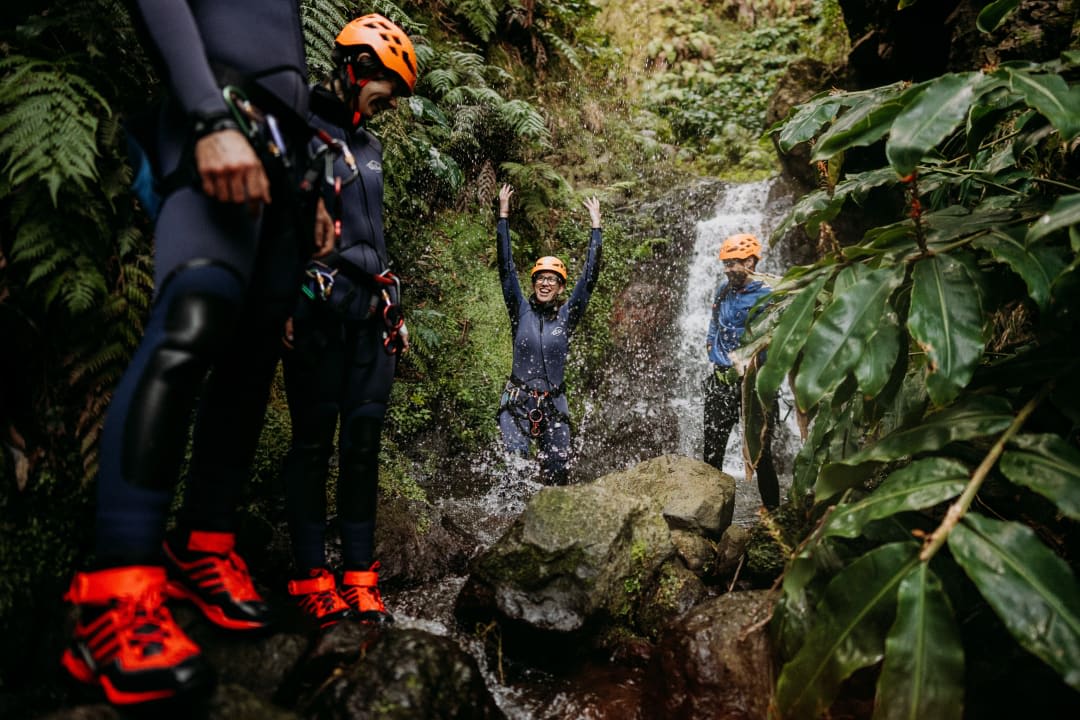
Discover thrilling canyoning in Madeira with waterfalls, pools, and hidden valleys for all adventure levels.
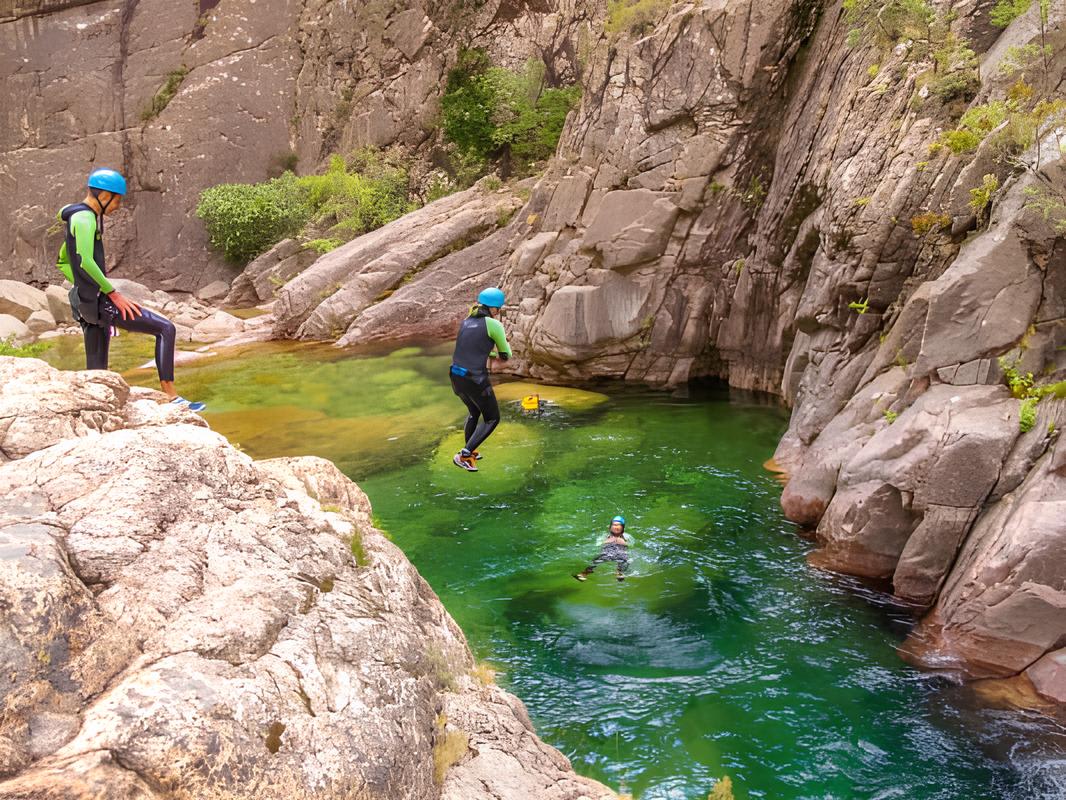
Many of France's most beautiful canyons can be found in Corsica. To help you discover them, here's our complete guide to canyoning in Corsica!

Discover the top 10 canyoning spots in Corsica: from the fun of Fiumicelli to the thrills of the Purcaraccia.
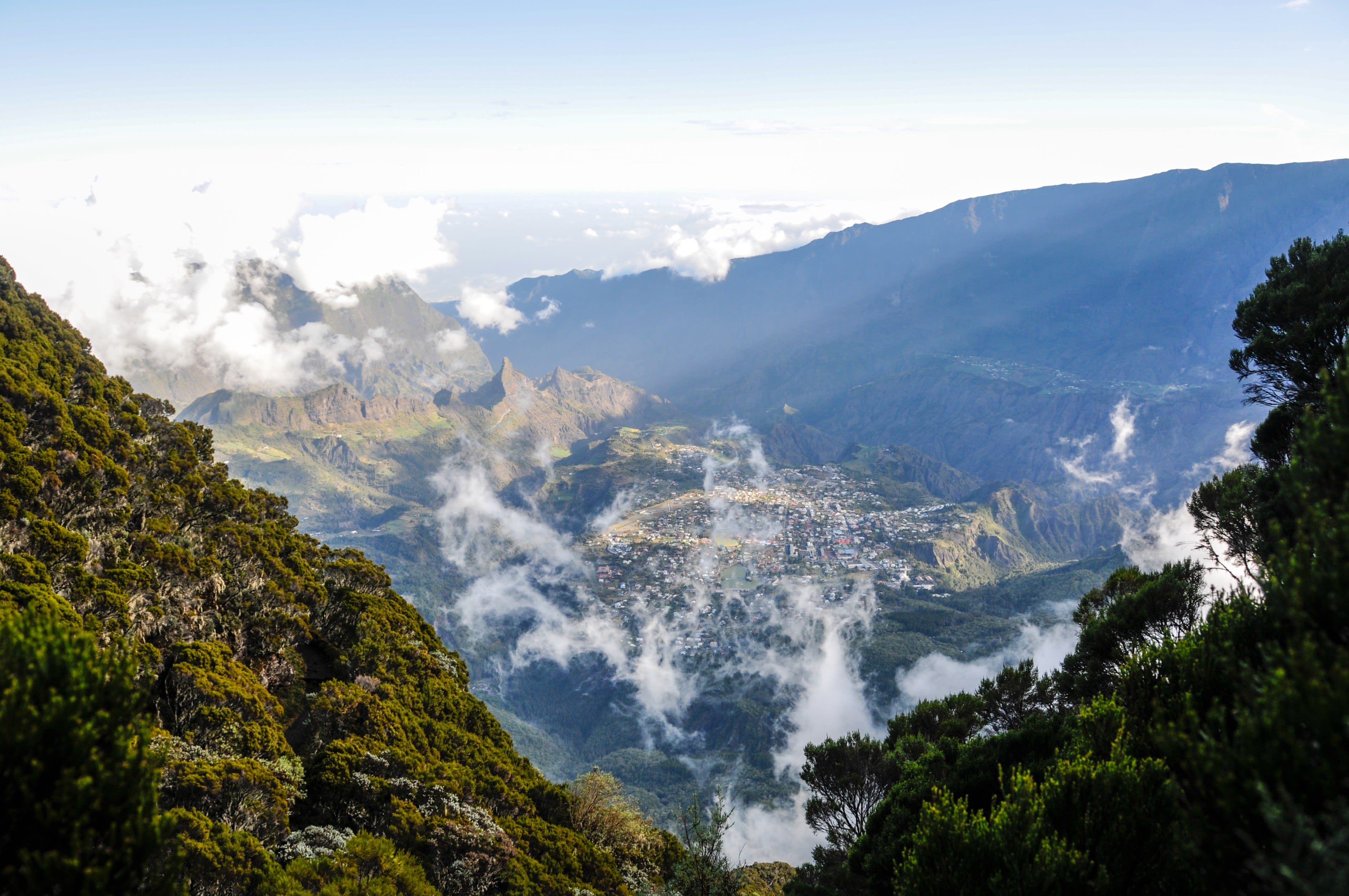
Visiting Réunion Island? Discover the different ways to visit the Cirque de Cilaos, one of the island's most impressive landscapes!
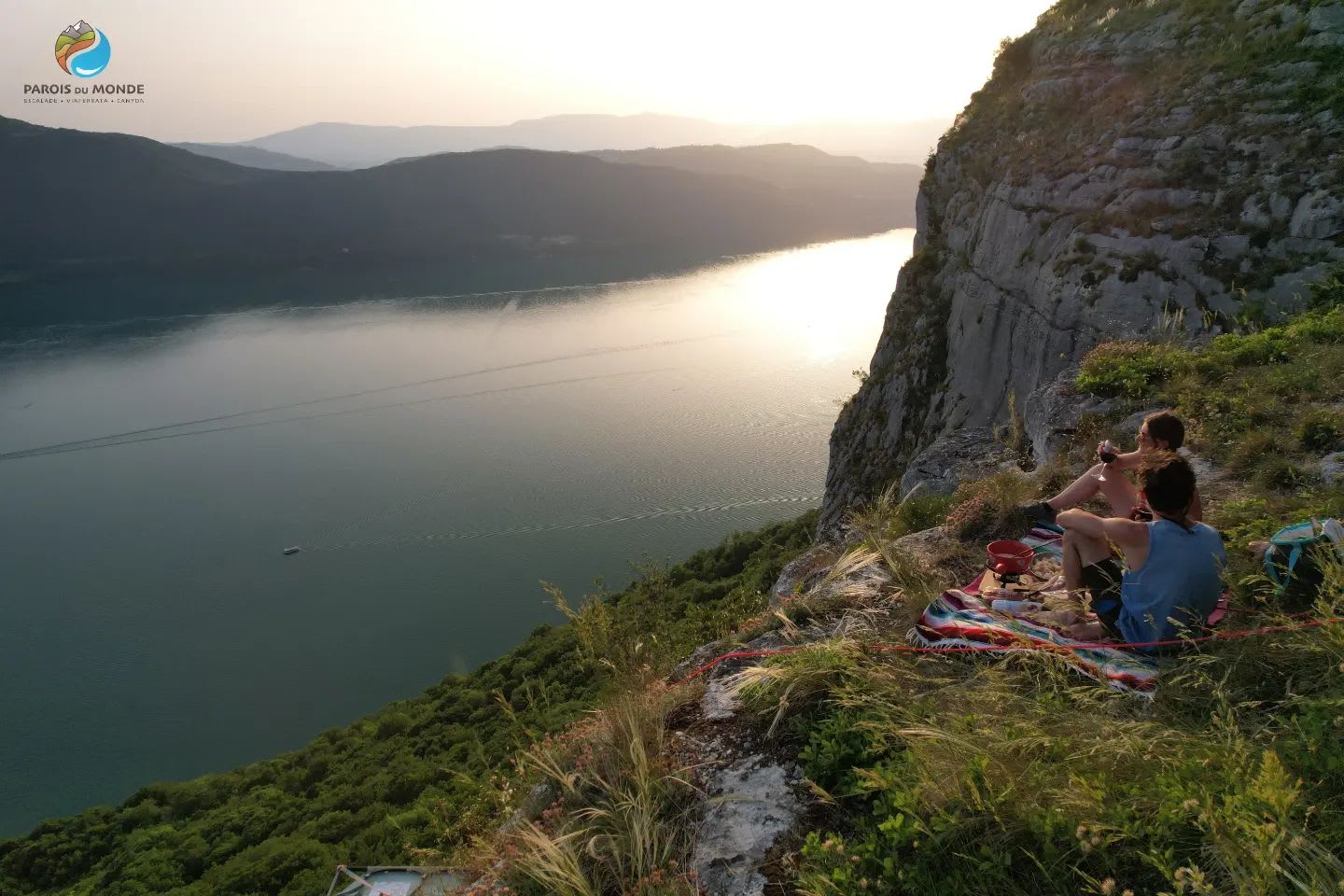
Discover the outdoor activities available at Lac du Bourget, choose the ones that suit you and head off for a great holiday in Savoie! Just 1h20 from Lyon, 1h from Grenoble and 40 m